

SAINT PETER’S BASILICA,
2009, graphite on paper, 15 x 11.5
$2200
In 1624 Pope Urban VIII commissioned Gian Lorenzo Bernini to design and build a Baldachin at the center of the new Saint Peter's Basilica transept. Built over the Papal Altar and Saint Peter’s Tomb, Bernini worked from 1624 to 1633 to complete his commission. I on the other hand only worked for a couple of weeks to complete this drawing.
The scale of the bronze baldachin, at 90 feet in height, highlights the immense size of the Basilica. The baroque style mimics the cloth canopies used to protect the Pope from the hot sun on Holy Days. The structure is decorated with twice life-sized angels looking down from the corners as well as Christian and Barberini (Pope Urban VIII family name) emblems.

SAINT PETER’S BASILICA,
2020, graphite on paper, 24 x 16
$500
Just inside the entrance to Saint Peter’s Basilica, on the first pier on the left, are two of Gian Lorenzo Bernini’s cherubs holding the holy water. At two meters in height, these marble sculptures are but a small part of Bernini’s contributions to the decoration of St. Peter’s. Depicting, in a drawing, the grandeur of the cavernous interior of St. Peter’s Basilica in Rome, Italy was equal parts Art & History. I love the way afternoon sunlight streams in through the high windows making ‘holy rays’ that highlight the grand transept. Studying the history helps me define the details to create a panorama in my drawing. Every drawing project has a learning curve and an opportunity to discover new and better ways to depict the subject.

I BAMBINI ANGELI
2010, graphite on paper, 7 x 5
sold
Just inside the entrance to Saint Peter’s Basilica, on the first pier on the north side of the nave, are Gian Lorenzo Bernini’s cherubs holding a holy water stoup. At two meters in height, these marble sculptures are but a small part of Bernini’s contributions to the decoration of St. Peter’s. Bernini, 1598 – 1680, who began working in the basilica as a sculptor in 1624, was appointed Architect of St. Peter’s in 1629, a post he held for the rest of his life.

Double Helix Spiral Stairs
$400
2025, graphite on paper, 11 x 14
The up & down stairs in the Vatican Museum in Rome is where the Spiral Staircase winds its double helix to guide tourists toward the Sistine Chapel at the end of their museum visit. The original staircase by Donato Bramante was built in 1505. It was large enough for pack animals and the Papal Carriage to ascend and descend. The modern staircase, installed in 1932 for pedestrians only, was designed by Giuseppe Momo. Still called the Bramante staircase, the double helix design allows uninterrupted up and down traffic on the two intertwined stairways.

REFLECTION RE – FLEX,
2018, graphite & pastel on paper, 10.5 x 17.5
SOLD
On a fine bright spring day at the top of the hill near the Sienna, Italy Campanile, I saw a reflection in a puddle of water in the street that was so intense and intricate it was like viewing a whole different world set out at my feet. I’ve always been fascinated with reflections, realizing that what the eye perceives and mind makes sense of is reflected light. I was attempting to create an Escher-esque sort of drawing, but when layering in the blue sky the work took on a look and feel beyond my expectations.

SANTA MARIA del FIORE,
2016, graphite on paper, 20 x 15
Sold
The Piazza del Duomo, which includes Santa Maria del Fiore with Brunelleschi’s Dome, the Baptistery, and Giotto’s Campanile (bell tower), is in the heart of the Historic District of Florence Italy. As my art mentor and I were walking through the Piazza one evening, I made the comment that I’d like to draw a night time scene of the Dome and Tower. He shook his head, questioning my ambitions, saying that it would be a monumental task to capture a recognizable view with any detail. It took eight years to get up the courage to tackle the project. This is the result. Depicting the night sky and the nighttime lighting of the architecture, in which the details fade into the shadows, required learning new techniques to apply graphite on paper. I love it when a drawing project all fits together into a recognizable composition.

SIENA CAMPANILI
2011, graphite on paper, 7 x 5
$100
It is a steep walk back down from the Duomo and Bell Tower that sit high on the hill overlooking Siena and the surrounding Tuscan country side. At the center of town is the Palazzo Pubblico. Completed around 1263, the entire cathedral, inside and out, is faced in stripes of black and white marble.

The Dream
$1000
2022, graphite and color pencils on paper, 20 x 16
Third Place drawing media, New Braunfels Art League Gallery
"Anything Goes" juried show February, 2022
“All That We See is but a Dream within a Dream”
Edgar Allen Poe ca. 1849
This drawing’s subject matter was inspired by a “Renaissance Revival Dinner” and reenactment we attended during a 2008 visit to Florence Italy. Along with the fine and tasty Italian hors d’oeuvres, abundant vino and dinner, the actors and attendants, all in Renaissance regalia, served comedy, drama and tragedy to a crowd of college students and tourists. The richly appointed palace and dining hall was the stage for a well crafted performance play reminiscent of a dreamscape where the audience becomes tangled in the telling of the plot. The dramas and fantasies that were spun like a web of intrigue around us haunt my dreams to this day.

FREAKED OUT
sold
2018, graphite on paper, 10.5 x 13
The Freaked Out Gargoyle drawing is inspired by the "Modern Gothic" architecture as found on many central Texas Courthouses built in the late 1800's and early 1900's. Carved in stone or cast in cement, gargoyles are both functional and mystical. This one is part bird, part bug and part monster of nightmares. As to function, they hang out on the walls near the roofline and direct rainwater runoff harmlessly away from the structure. As Myth they protect the home and people to whom they are assigned: This one has been assigned to guard, love and protect you, your family and home from idiot politicians, robo-calls and ner-do-well would-be thieves for years to come.

Neque Illic Mortuus
2024, graphite on paper, 11 ¾ x 11 ¾
SOLD
I drew this image as a caricature of a real tomb memorial after pondering the messages inscribed in Latin: Neque hic Vivus, Neque Illic Mortuus It appears as an inscription on the tomb of Giovanni Battista Gisleni, in the Basilica of Santa Maria del Popolo in Rome, Italy. The architect designed his own macabre funeral monument in 1672, including the two inscriptions on the marble facing, which are said to explain the logic of the memorial: “Neither living here, nor dead there.” The inscriptions on the medallions translate; “I will die in my nest,” and “I will multiply my days like a Phoenix.” There is a bit of artistic license taken and expressed in this drawing, but the message remains the same.

Il LEONE,
2010, graphite on paper, 13 x 15
SOLD
In the Loggia dei Lanzi at the Piazza della Signoria in Florence, Italy, I fell in love with the Worried Lion, one of the two 12 foot long stone lions that bracket the stairs to the Loggia. There is so much history and emotion in the art and architecture of Italy it is often difficult to pick a focus for a drawing, but The Worried Lion made it easy because he is such a powerful guardian of the loggia. Carved by Flaminio Vacca in 1600 for the Grand Duke of Tuscany this sculpture is almost a mirror image of it’s Roman inspiration. When the Grand Duke sold his Villa in Rome, both lion statues were brought to Florence.
To the left of the Lion is Perseus, holding the head of the Medusa, a bronze masterpiece by Benvenuto Cellini, placed in the Loggia in 1554. The marble base is a copy of the Cellini/Francesco del Tadda collaboration that has been moved to the Bargello Museum.

SHOPPING IN LUCCA
2009, graphite on paper, 9 x 13
SOLD
The Piazza Anfiteatro in the walled city of Lucca, Italy (a few kilometers north of Pisa) was at one time a Roman amphitheatre. Now shops and apartments face into this popular piazza that has become a trendy destination for locals and tourists alike. On this particular Sunday afternoon the local antique auto and motorcycle club ended their rally at the piazza. This image of two local shoppers was inspired by a reflection in the fuel tank of a wonderfully restored ‘Matchless’ motorcycle.

THE PANTHEON,
2009, graphite on paper,13 x 9
SOLD
The “Temple of All Gods” in Rome, Italy, was built during Hadrian’s rule as emperor, 117 to 138 AD. In a tribute to Roman concrete, this view looks up past one of the niche enclosures to the dome 142 feet above the floor. In the 6th century the temple was converted from “pagan” to Christian and many of the interior decorations were removed.

SANTA MARIA della SALUTE,
2012, graphite on paper, 14.5 x 19.5
$3300.
From the outside, the two domes and two bell towers make this church a baroque icon of Venice. Under the main dome is the octagonal rotunda or nave where the 6 foot wide polished silver chandelier hangs over the polychrome marble mosaic floor. Called a ‘Minor Basilica’, the Chiesa Santa Maria della Salute (The church of Virgin Mary of Good Health) is located in the Dorsoduro district of Venice, Italy, cattycorner across the Grand Canal from San Marco. It was built as a tribute to the city’s delivery from the black plague. The unusual octagonal design by Baldassare Longhena was commissioned in 1630, consecrated in 1681, and completed in 1687. The mosaic floor ringing the center of the nave is a symbolic reference to the Marian Rosary, with the Fifteen Promises and the Fifteen Mysteries. Under the smaller dome, across the nave from the grand entry way, is the main chapel and altar dedicated to Santa Maria. There are six smaller chapels, three on either side of the main chapel, some decorated with paintings and frescoes by Titian and Tintoretto.

PROPHETS AND PATRIARCHS,
2010, graphite on paper, 14 x 11
$2200
The Duomo di Siena (Cathedral of Siena) in Siena, Italy, was designed and built between 1215 and 1263. The interior of the nave and transept is decorated in black and white marble stripes, the traditional colors of Siena’s civic coat of arms. The dodecagonal dome is supported by six pillars, each adorned with statues of Siena’s patron saints. Above the saints, ringing the dome’s ‘drum’, is a columned gallery of statues of patriarchs and prophets.

IL COLOSSEO,
graphite on paper, 2010, 14 x 12.5
SOLD
I drew this view of the Flavian Amphitheater, aka the Colosseum, to highlight the de-construction and show how the nearly 2000 year old structure looks today. While the columns and capitols that adorn the standing outside wall are iconic, the view into the interior hallways had more mystery. This drawing looks inside the passage ways of the outer two rings and up at the inside of the still standing north outer wall. My drawing was created by combining the ambiance of the afternoon sunlight and nighttime lights. The Colosseum was built by Vespasian and his son Titus between AD 69 and AD 80. The square blocks of travertine, tufa, and the brick and marble are held together with iron clamps, not mortar. In almost continuous use between AD 80 and 1550 the Colosseum has housed many activities other than gladiators; now days it is religious services and rock concerts. Restoration, reconstruction and capping of the remaining structure began in 1805 and continues to this day.

SAN GIMIGNANO,
2010, graphite on paper, 12 x 15
SOLD
Looking out of a peaceful alabaster shop window on a warm spring afternoon toward Porta San Giovanni. “The City of Towers”, established in the 3rd century BC as an Etruscan trading village, was later named after St. Geminianus, who defended the city against Attila’s Huns c 452. During San Gimignano’s most prosperous years, 1100’s to early 1300’s, more than 70 towers were built within the city walls. Now only 15 still stand.

THESE EYES OF STONE
2009, graphite on paper, 13” x 9”.
$300
Pisa, Italy, in the Piazza dei Miracoli where the Leaning Tower, Cathedral, Baptistery and the Camposanto Monumentale stand, Holy Soil from Golgotha was deposited after the 3rd Crusade, circa 1192. This grave yard has such a powerful, spiritually inhabited ambiance I was in tears of loss and love the entire time I was there. Within the walls of the cemetery is a carved figure of a woman. Her dreamy, wistful expression speaks of waiting and unrequited love. She cried out to me to capture her visage and help her find love. Her plaque, written in Italian, translates: “I have been waiting nine hundred years. These eyes of stone see only shadows. Please bring the light, my love.”

SAN MINIATO,
2009, graphite on paper, 13 x 9
SOLD
Overlooking the city of Florence on the Monte alle Croci (Hill of the Crosses) stands the Church of San Miniato al Monte. Behind the thousand year old church is part of the city wall, built by Michelangelo during the siege of Florence, which now encloses the Cimitero delle Porte Sante installed in the 1850’s. This monumental cemetery was created to the taste of the time using Romanesque, neo-gothic and neo-Renaissance monuments proclaiming the greatness of important Florentines and families such as Carlo Collodi (Creator of Pinocchio), painters, politicians, authors and business men.

ORVIETO ITALY,
2014, graphite on paper, 20 x 15
$1250
At the intersection of six streets in Orvieto, Italy, about 90 kilometers north of Rome, I saw an iconic scene of an Italian Hill Town with Vineyards & villas in the background. Capturing the look and feel of the buildings and cobblestone streets was a worthy challenge for me and my worn-out pencils. This historic “Hill Town,” is known for it’s grand architecture from the 13th and 14th centuries which looks out over the walls and cliffs that have protected the city for over a thousand years. Even though our visit to Orvieto was dampened by one of the worst thunderstorms we’d ever seen, it did not stop me from recognizing the artful scene of this intersection. As I was getting out the expensive paper to begin this drawing I imagined an image of a street scene taken in the morning sunlight. The idea of infusing sunlight and shadows into my drawing only made it more appealing and heart felt. At the intersection of these streets is a little museum, Museo delle Maioliche (Museum of Ceramics) that celebrates the History and Art of the Etruscan, Roman and Renaissance times.

To Florence With Love
Sold
Florence Italy street scene.
2020, 10 x 18, graphite & color pencils on paper

PISA DUOMO,
2009, graphite on paper, 13 x 9
$400
This view looks up into the interior of the frescoed dome of the cathedral designed and built by Buscheto at the Piazza dei Miracoli in Pisa, Italy. Construction of the cathedral was begun around 1063 (the Leaning Tower, just outside, was begun in 1173). The foreground of this drawing is dominated by the artist’s rendition of Giovanni Pisano’s sculpted pulpit, circa 1303. The panel shown is the “Presentation in the Temple”. A fire in 1595, and allied bombings during WW II nearly destroyed the cathedral and interior art works.

BASILICA di SAN MARCO,
Venice, Italy,
2012, graphite on paper, 21 x 15
$3500
Hunting Art Prize Finalist, Houston, Texas, 2013
This image looking down the left side aisle and into the apse was created because I loved the mystery of the statuary and glass mosaic story telling. On the left, is the side aisle leading to St. Peter’s Chapel. On the right is the dome above the Presbytery with the magnificent Ambo, or pulpit, in between. Covered entirely in a background of gold, the mosaics on the walls, arches and domes of the Basilica Catledrale Patriarcale di San Marco (Chiesa d’Oro) depict stories and events from the New Testament, mostly dedicated to St. Mark the Evangelist. The basic structure of the basilica is a Greek cross with a mixture of Italian and Byzantine architecture completed approximately 1094 . The Church has been a work in progress with many mosaics completed in the 1200’s and adornments from Constantinople, Alexandria, Syria, and the Near and Far East being brought in and installed from the 12th to the15th centuries.

PALAZZO MEDICI, FIRENZE
2014, graphite on paper, 20 x 14.5
SOLD
This drawing of the Medici Palazzo is my second attempt to capture the mood of this court yard. In our second tour of Florence we visited the palazzo and got a better understanding of the architecture and adornments. In my drawings artistic license is often exercised for the sake of the composition and aesthetics, but I usually try to stay fairly true to what my eye actually sees. Like the sunlight, illuminating with an other-worldly grace, the sculpture in the center of the open courtyard. “Draw what you see, you don’t have to make it up too much.”

At The Colosseum
2014, graphite on paper, 9.5 x 7

Many of the following images are plein air drawings scanned right out of my 2008 drawing book. As part of the 2008 Texas State University's Study Abroad in Italy, we were often taken to monumental statues and frescoes and tasked with drawing what we saw. Sometimes we were given only a few minutes, sometimes up to an hour or more. With each drawing we learned more about the renaissance period, the artists and Italy's history and culture.

The following drawings are from my
2008 Study Abroad in Italy drawing book.

The Rape of the Sabines

PALAZZO MEDICI RICCARDI,
2008, Graphite on paper, 13 x 9
SOLD
I drew this image of the Palazzo Medici in Florence, Italy, because one of my artistic heroes, Michelangelo, began his apprenticeship in the Arts here under the patronage of the Medici Family. On our first visit in 2008, the Palazzo Medici Riccardi was closed to the public, but the sunlight streaming into the portioced open courtyard gave the scene an other-worldly grace. I stood for some time looking in through the locked gate, composing in my mind how I might draw the view with my pencils. The Palazzo was built between 1444 and 1460 by Florentine architect and sculptor Michelozzo Michelozzi for the Medici family. The sculpture that dominates the central courtyard is of Orpheus and Cerberus by Baccio Bandinelli, ca. 1515.

FACES
2008, Graphite on paper, 13 x 9, $400
This is my epiphany picture. In our visit to the Uffizi Gallery my art mentor gave us an assignment to copy freehand one face each from four paintings by famous Renaissance artists. This is the page out of my drawing book from my 2008 visit to Florence, Italy. As I was drawing the faces, I began to have hope for me as an artist...that I could actually draw and fairly accurately reproduce on paper what I was seeing. Upper left, sketch of Sant’ Anna by Leonardo. Upper right, Testa di Giovane Donna by Furini. Lower left, Testa di Donna, probably by a student of the Michelangelo scuola. Lower right, sketch of Sant’ Giovannino by Andrea del Sarto.

THE DAVID
2008, 13 x 9.
Drawn on site in the Academia, Florence, Italy.
The original David statue by Michelangelo was laboriously transferred from the Duomo Workshop where it was sculpted 1501 to 1504 to the Palazzo Vecchio in the Piazza della Signoria, then to the Gallery of the Academy of Fine Arts in 1873 to protect it from the weather. The David, installed in the Piazza in 1504, became an icon of Florentine liberty. It was damaged during a siege of the Palazzo Vecchio in 1524. A heavy object, thrown from an upstairs window, broke off the statues right arm which was spirited away and hidden for many years before being returned and reunited. During my 2008 visit to the Academia Museum I was fortunate that a fellow tourist offered me her seat where I was able to complete this drawing in about 40 minutes.

Warrior at night
Menelaus supporting the body of Patroclus
This statue is an ancient Roman copy of a classic Greek work

Piazza della Repubblica
2008, graphite on paper, 13 x 9
SOLD

Hercules defeating Nessus the centaur

THE GROTTO OF MOSES
graphite on paper, 13 x 9
$300
Palazzo Pitti courtyard, Florence, Italy. The statue of Moses by Raffaello Curradi & Cosimo Salvestrini, 1635, and the statue of The Law by Antonio Novelli, 1635, keep watch over the wrestling and swimming cherubs by Pompelo Ferrucci del Tadda, 1636, in the grotto’s pool. The plaque at the feet of Moses translates from Italian: “Behold the leader of the Israelites as he draws water from the rock.”

Mary comforting JC

The Rape of Polyxena

HERCULES AND CACUS
2008, graphite on paper, 13 x 9
A larger than life statue by Baccio Bandinelli, 1534, of the mythical Hercules defeating Cacus, placed in the Piazza Signoria, Florence. Considered by the Florentines of the time to be a second rate statue, the locals refer to it as the “sack of potatoes” because of the exaggerated muscles.

The Gate
2009 graphite on paper, 9 x 13

Roman Forum Ruins
2008, graphite on paper, 13 x 9
sold
Detail of excavation and partial reconstruction of the Forum of Julius Caesar. View from Via dei Imperiali, looking toward the
Temple of Vespasian.
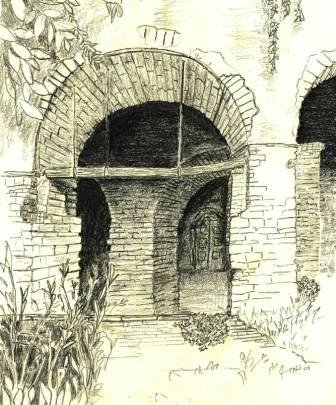
THE OLD CITY WALL
2008, 13 x 9
The rumor is that Michelangelo had something to do with the designing and construction of this brick and stone fortification around the South side of Florence.

Cinque Terre
Experience Italy
I’m staying true to only drawing those things I have seen with my own eyes, or dreamed up from inspiration. This page is devoted to my Italy Portfolio. These images were inspired by the places we visited in our travels. During our first visit to Italy with the Texas State Study Abroad Program, like when the old masters were students, we were placed in front of various statuary and frescos and tasked with drawing in our drawing books what we were seeing. Time limits were imposed and we learned to sketch and embellish quickly and efficiently.
Even though I was not technically a student, (Diane was working toward her BFA degree, I went along as a ‘spare tire’), I participated in the assignments and thoroughly enjoyed the grand art history tour and drawing instruction. My drawing book, so full of my attempts to capture the essence of the artwork of some of the old masters, received an “A”. That validation was enough to return me to the path that I had dreamed of following since my elementary school days.